Betting Strategies for Roulette: Myth vs. Reality: The GTSpins Breakdown
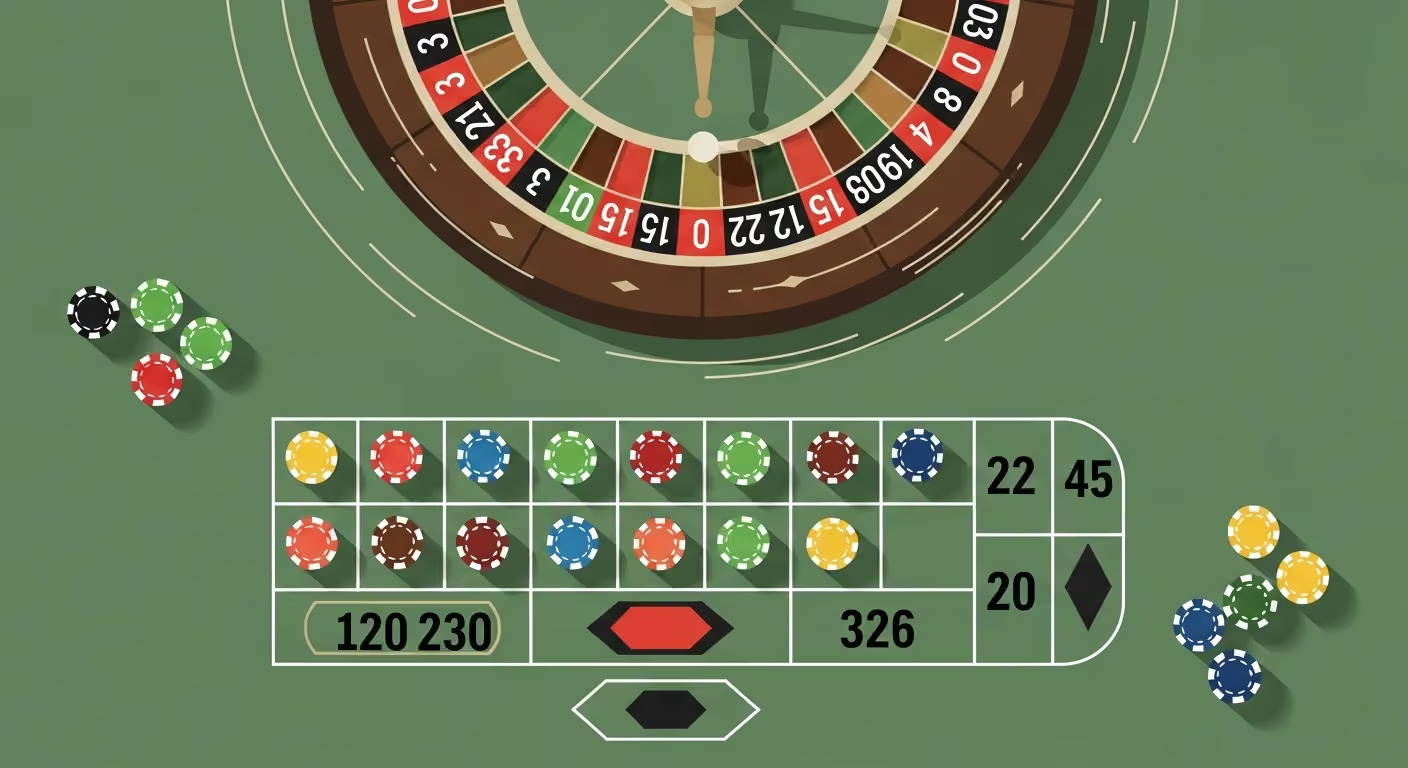
You watch the ball spin, land on red — again. The player next to you doubles their bet with quiet confidence, convinced the system is on their side. Sound familiar? Roulette tables are full of players who swear by a betting strategy, yet the wheel has no memory. This post is a side-by-side breakdown of the most common roulette betting strategies at GTSpins, cutting through the myth to show you what each approach actually delivers — and where it falls short.
The Basics
Every roulette betting strategy falls into one of two camps: progressive (bets change after each spin) or flat (bets stay the same). Progressive systems respond to wins and losses; flat betting ignores outcomes entirely. Neither approach changes the house edge — European roulette sits at 2.7%, American at 5.26% — but each creates a distinct session experience in terms of variance and bankroll demand. Understanding that distinction is the real slot game guide to any table game, roulette included.
| Option | Best For | Drawbacks |
|---|---|---|
| Martingale | Players chasing short winning sessions | Exponential bet growth; hits table limits fast |
| Fibonacci | Cautious players who want a structured system | Slow recovery; still loses to a long cold streak |
| D’Alembert | Moderate bankrolls seeking gentle progression | Profits are small; long sessions needed to recover losses |
| Flat Betting | Players focused on longevity and bankroll control | No upside multiplier; wins are capped by stake size |
Where to Begin
If you are new to structured roulette play, start by choosing a bet size that lets you sustain at least 50 spins on your session bankroll. This gives any system enough room to breathe before you hit natural variance swings. At GTSpins, the roulette lobby spans tables with minimum bets as low as €0.10, which makes it practical to test a strategy without committing serious funds. Treat your first session as data collection, not a profit run.
The best analogy for new players is the same one used in a solid slot game guide: know your session budget before the session begins, not during it. Roulette — like slots — rewards players who set a hard stop-loss and stick to it. Decide your maximum loss threshold and your take-profit target before the first spin. Write them down if you have to.
- Unit size — set your base bet at 1–2% of your total session bankroll to survive long losing sequences.
- Table limits — check the max bet ceiling before picking a progressive system; Martingale collapses when you hit it.
- Game variant — always prefer European or French roulette; the single zero cuts the house edge nearly in half versus American.
- Session length — cap your sessions by time or spin count, not just money, to avoid fatigue-driven decisions.
Takeaway
The central reality of roulette betting strategies is that none of them overcome the house edge. What they do is shape how you lose or win during a finite session. The Martingale can produce many small wins followed by one catastrophic loss; flat betting produces a smoother, predictable curve. Neither outcome is inherently better — it depends entirely on what you want from a session.
GTSpins recommends treating any strategy as a discipline tool rather than a profit engine. A system keeps your bet sizing consistent and removes impulsive decisions from the equation. That behavioral benefit is real, even if the mathematical one is not. Responsible gambling always starts with knowing the difference.
What to Look For
When evaluating whether a strategy suits your play style, focus on three practical factors: volatility tolerance, bankroll depth, and session goal. A player who wants excitement and can absorb swings may enjoy the Martingale for short bursts. A player who wants to extend table time and keep variance low should gravitate toward D’Alembert or flat betting. Neither choice is wrong — misalignment between strategy and goal is what creates frustration.
This is the same framework you would apply reading any quality slot game guide: match the volatility of the game (or strategy) to your own risk profile. High-variance strategies, like high-variance slots, can deliver bigger peaks — but the valleys are deeper and arrive faster than most players expect.
- Volatility — Martingale and Fibonacci are high-volatility approaches; D’Alembert and flat betting are low-volatility.
- Bankroll requirement — Martingale can demand 64× your base bet after just six consecutive losses; ensure you can cover it.
- Table rules — some tables offer La Partage (half your even-money bet returned on zero), which reduces the house edge further on outside bets.
- Win condition — define what a successful session looks like before you start — a percentage gain, a fixed euro amount, or simply enjoying the time played.
Key Takeaways
Roulette strategy is less about finding a winning formula and more about managing your own behavior at the table. The myths — that a number is "due," that a strategy beats the house, that streaks are predictable — are contradicted by basic probability. Every spin is independent. The wheel does not remember the last twenty results, and no system can make it do so.
What you can control is bet sizing, session duration, and game selection. Those three levers do more for your long-term roulette experience than any progression sequence. At GTSpins, the tools to make informed choices — game filters, bet limits, session timers — are all available in the player account dashboard.
- No strategy beats the house edge — this is a mathematical fact, not a pessimistic opinion.
- Progressive systems raise variance — they do not improve expected value; they redistribute wins and losses across a session.
- Flat betting maximizes session longevity — if staying at the table longer matters to you, fixed stakes are the most reliable path.
- Game selection matters most — choosing European over American roulette saves nearly 2.5% on every bet, compounding across hundreds of spins.
Step-by-Step Guide
Ready to put theory into practice? Here is a straightforward process for applying any roulette strategy responsibly at GTSpins. Follow these steps before and during your session to keep decision-making clear and emotion out of the picture.
- Set your bankroll — decide the total amount you are willing to risk for the session. This number should be money you are comfortable losing entirely.
- Choose your base unit — set your base bet at 1–2% of the session bankroll. For a €100 session, that means a €1–€2 base bet.
- Select a strategy — pick one approach from the table above and commit to it for the full session. Switching mid-session distorts results and usually signals tilt.
- Pick the right table — use GTSpins’ lobby filters to find a European roulette table with a minimum bet that matches your unit size and a maximum bet at least 64× your base unit if using Martingale.
- Set your exit conditions — write down your stop-loss (e.g., lose 30% of bankroll) and your take-profit (e.g., up 20%). Close the table when either triggers, no exceptions.
- Review and log — after the session, note how many spins you played, your net result, and whether the strategy felt sustainable. Over multiple sessions, patterns in your own behavior — not the wheel’s — become clear.
Applying this kind of structured, slot game guide-style discipline to roulette transforms a game of pure chance into a managed experience. The house edge remains, but your relationship with variance becomes something you understand and plan for — rather than react to in the moment. That is the real edge any informed player can gain at the GTSpins table.